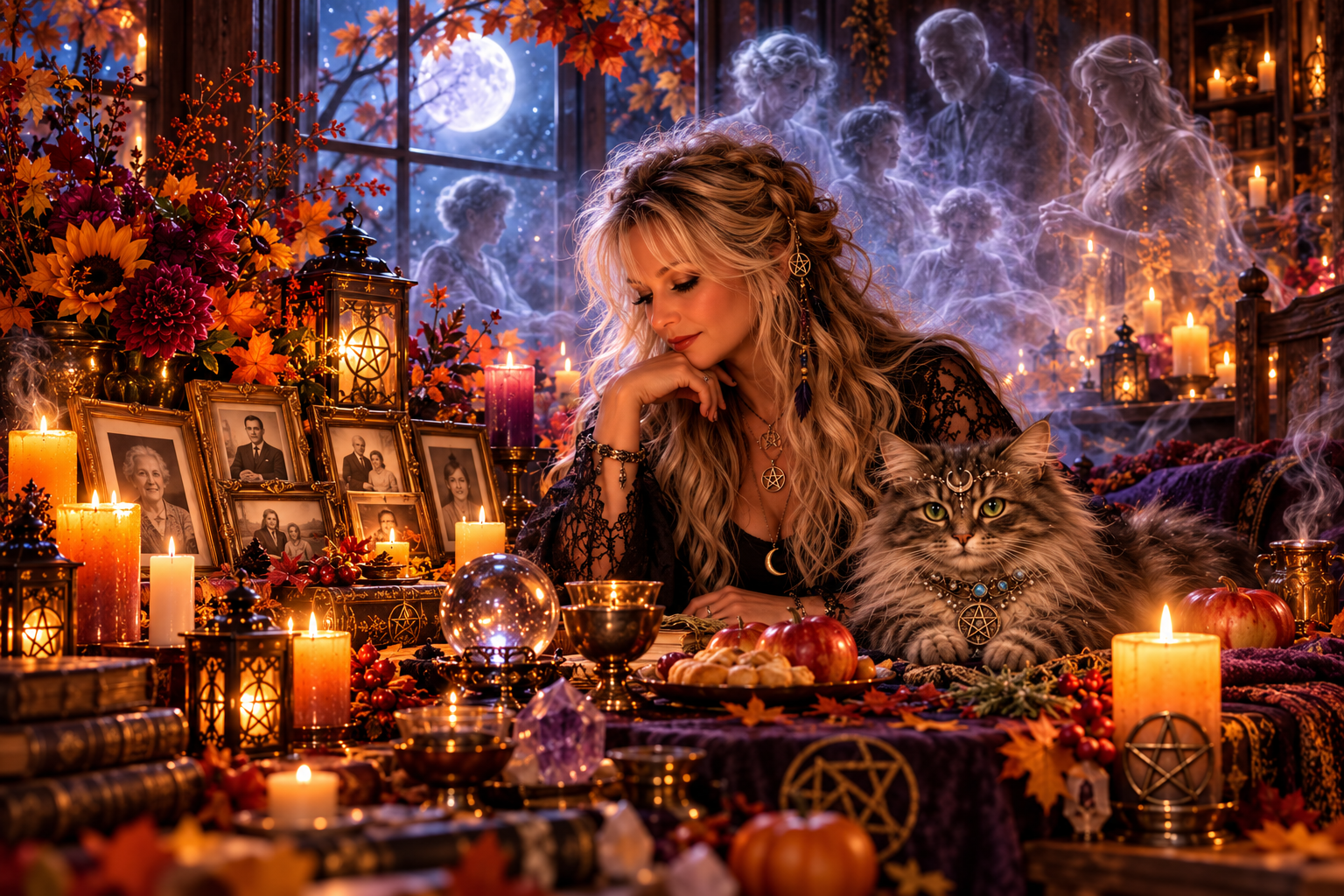
The Thinning of the Veil: How to Honor and Speak to Your Dead
As autumn deepens and the nights grow longer, many spiritual and witchcraft traditions turn their attention toward those who walked before us. The phrase “the thinning of the veil” describes the belief that, during certain sacred times—particularly around Samhain—the boundary between the world of the living and the realm of the dead becomes easier to approach.
Whether we understand this veil literally, spiritually, symbolically, or as part of ancestral tradition, this season offers us something precious: a time to remember.
Honoring the dead does not have to be frightening or elaborate. It can be as simple as lighting a candle beside an old photograph, preparing a loved one's favorite meal, saying a name aloud, visiting a grave, or sitting quietly with memories that have not been visited in a long time.
The dead we honor need not be blood ancestors, either. Our beloved dead may include parents, grandparents, children, siblings, spouses, friends, teachers, mentors, and others whose lives touched ours. Some practitioners also honor distant ancestors whose names have been lost to time.
An ancestor altar can provide a beautiful focal point during this season. You might place photographs, heirlooms, flowers, candles, written names, or meaningful objects upon it. A small offering may also be given—a cup of coffee, tea, water, bread, fruit, sweets, or a food the person loved in life.
Then, simply speak.
Tell them what has happened since they have been gone. Tell them that you remember them. Tell them what you miss. Share the funny stories. Cry if you need to. Sit silently if words will not come.
There is no requirement that something supernatural happen.
Some people describe sensing a presence, experiencing meaningful dreams, remembering something unexpectedly, or noticing a familiar scent or song. Others experience nothing unusual at all. Neither experience makes the act of remembrance more or less meaningful. The purpose is not to force proof of contact with the dead. It is to create sacred space for love, memory, ancestry, grief, and connection.
A Spell for Speaking Across the Veil
You will need:
A white candle
A photograph or written name of the person you wish to honor
A small glass of fresh water
A favorite food, flower, or other simple offering
A quiet place where you will not be disturbed
Place the photograph or name before you. Set the water and offering beside it and light the candle.
Rest your hands comfortably and breathe slowly. Think about the person you are honoring. Remember their face, their voice, their laugh, or simply the feeling of knowing them.
When you are ready, say:
“By candle flame and autumn night,
I call your memory into light.
Not bound by fear, not called by force,
But welcomed here through love's own course.
Beloved dead whom I hold dear,
In sacred memory, draw near.
Across the veil, if you may hear,
Know you are remembered here.
I offer water, flame, and fare,
A place of honor, love, and care.
If words may travel where you dwell,
Hear now the things I wish to tell.”
Now speak freely.
Say the person's name. Tell them whatever rests upon your heart. You may ask a question, but allow silence to be part of the ritual. Do not strain to hear an answer or interpret every sound, shadow, or thought as a message.
When you have finished, say:
“The words are spoken, the candle burns,
And each to their own realm returns.
With love I opened, with love I close;
In peace you rest, in peace I go.
No spirit unwanted may remain;
This sacred space is mine again.
Remembered always, honored still—
Depart in peace, by love and will.”
Extinguish the candle safely. Leave the glass of water for the remainder of the evening if you wish, then pour it onto the earth or down the drain. Food offerings can be disposed of respectfully rather than eaten if that better fits your practice.
Remembering Is Its Own Kind of Magick
Speaking to our dead is ultimately an act of remembrance. Death may end a physical life, but it does not erase the influence a person leaves behind.
We carry people in recipes written in familiar handwriting, expressions we unknowingly inherited, stories told around kitchen tables, photographs tucked into boxes, songs that suddenly make us cry, and lessons we did not realize we had learned until years later.
During the thinning of the veil, we turn toward those memories intentionally.
Light the candle.
Speak the name.
Tell the story.
Remember the love.
For perhaps the greatest offering we can give our beloved dead is very simple:
You were here.
You mattered.
And you are remembered.
— Witches’ Hallow